
1. Introduction
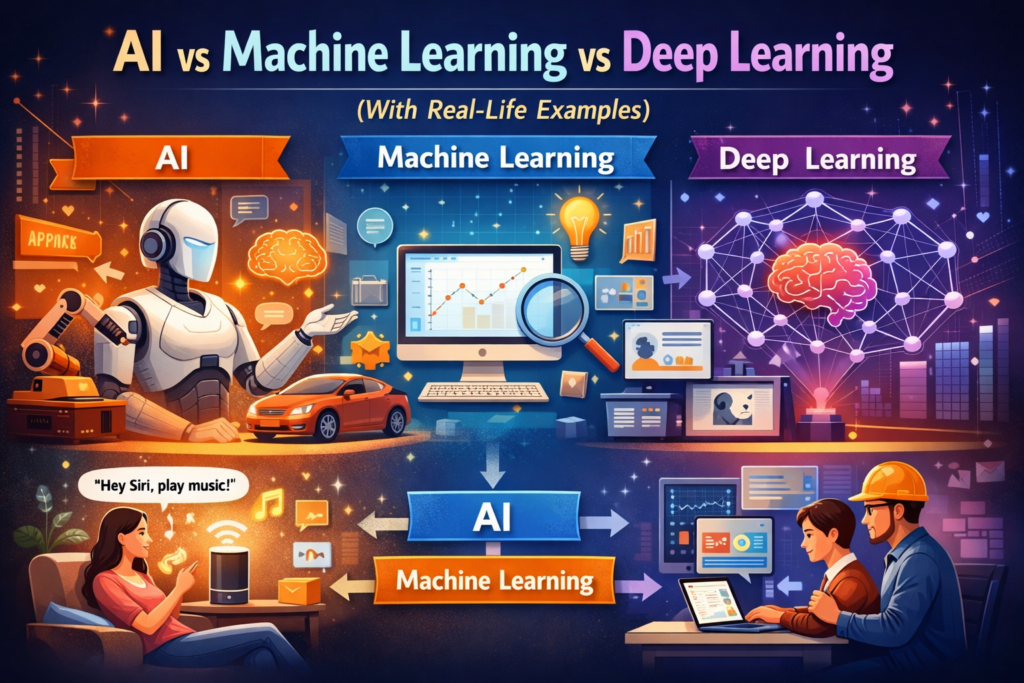
The terms Artificial Intelligence (AI), Machine Learning (ML), and Deep Learning (DL) often cause confusion for new learners. These topics are important because they represent different levels of computer intelligence, and we see them everywhere in daily life. For example, when you talk to a voice assistant or watch personalized recommendations online, behind the scenes AI and ML are at work.
Think of AI, ML, and DL like levels of a school curriculum: AI is the broad subject (like “Science class”), ML is a specific chapter (like “Chemistry”), and DL is an advanced topic within that chapter (like “Organic Chemistry”). This analogy helps us see why they overlap and why the terms can be confusing at first. In this article, we will break down each concept in simple terms, use real-life examples, and even include some text diagrams to make the ideas clear.
(For related topics, you might explore our sections on an AI roadmap, introduction to Machine Learning, or courses on AI, but here we will focus only on explaining these concepts clearly.)
2. Basic Definition (Very Simple)
- Artificial Intelligence (AI): Imagine a smart robot or program that can do tasks usually done by humans. AI means creating machines or software that can think or make decisions. For example, a voice assistant (like Siri) that understands your questions is an AI system. AI can work by following rules or by learning from examples.
- Machine Learning (ML): This is a type of AI where the machine learns from data. Instead of being explicitly programmed for every step, the machine looks at many examples and figures out patterns or rules on its own. For example, a program that learns to identify spam email by looking at hundreds of spam and non-spam emails is using ML.
- Deep Learning (DL): This is a special kind of machine learning. It uses layered structures called neural networks (inspired by the human brain) to learn complex patterns. Deep Learning is like giving the machine a very deep stack of “lessons” so it can learn on its own at multiple levels. For example, an app that recognizes your face in a photo or transcribes speech to text often uses deep learning.
Here is a simple way to remember: AI is the big idea – making machines smart. ML is one way to do it – by learning from data. DL is a more advanced way – using neural networks and lots of data.
3. Core Concepts (Step-by-Step)
Artificial Intelligence (AI)
- Broad Field: AI is a wide area of computer science. It includes any technique that makes machines behave intelligently. This can be rule-based (like an expert system that follows coded rules) or learning-based (like ML).
- Goal of AI: The goal is to solve problems or make decisions that normally require human intelligence, such as understanding language or recognizing images.
- Examples: Games like chess programs, virtual assistants (Siri, Alexa), self-driving cars, and even some robotics use AI.
- Techniques: AI can use simple if-then rules or more complex algorithms. For example, an expert system might use a list of symptoms to guess a diagnosis, while other AI might use probability and statistics.
Machine Learning (ML)
- Learning from Data: ML is a subset of AI where the system learns from data. Instead of a programmer writing all the rules, the machine figures out rules by looking at many examples.
- How It Works: ML algorithms take a lot of data as input and train a model. This model can then make predictions or decisions on new data. For example, a spam filter ML model is trained on many emails labeled “spam” or “not spam.”
- Types of ML:
- Supervised Learning: The algorithm learns from labeled examples (input and known output). For example, predicting house prices from known data (input: house features, output: price).
- Unsupervised Learning: The algorithm finds patterns in unlabeled data. For example, grouping customers by buying habits without being told the categories in advance.
- Reinforcement Learning (advanced): The algorithm learns by trial and error, like a game-playing AI learning the best moves through feedback (rewards or penalties).
- Example: A recommendation system (like Netflix suggesting movies) uses ML by learning your preferences from past viewing history.
Deep Learning (DL)
- Neural Networks: Deep learning uses structures called neural networks. Imagine many layers of simple decision-making units (like artificial neurons) connected together. Each layer learns a different level of pattern.
- “Deep” Structure: The “deep” in deep learning means many layers (dozens or even hundreds) of these neurons. More layers allow learning more complex features from data.
- When It’s Used: DL is especially powerful for tasks like image recognition, natural language processing (understanding text), and speech recognition. For example, recognizing a dog in a photo or translating a sentence to another language often uses deep learning.
- Needs More Data/Compute: Deep learning usually requires a lot of data and computing power (like powerful graphics cards) because of the many layers.
- Example: A social media app that automatically tags your friends in photos likely uses a deep neural network to recognize faces.
4. Visual Explanation (Text-Based Diagrams)
Sometimes seeing a simple diagram helps understand the relationship between AI, ML, and DL. Below are text-style diagrams:
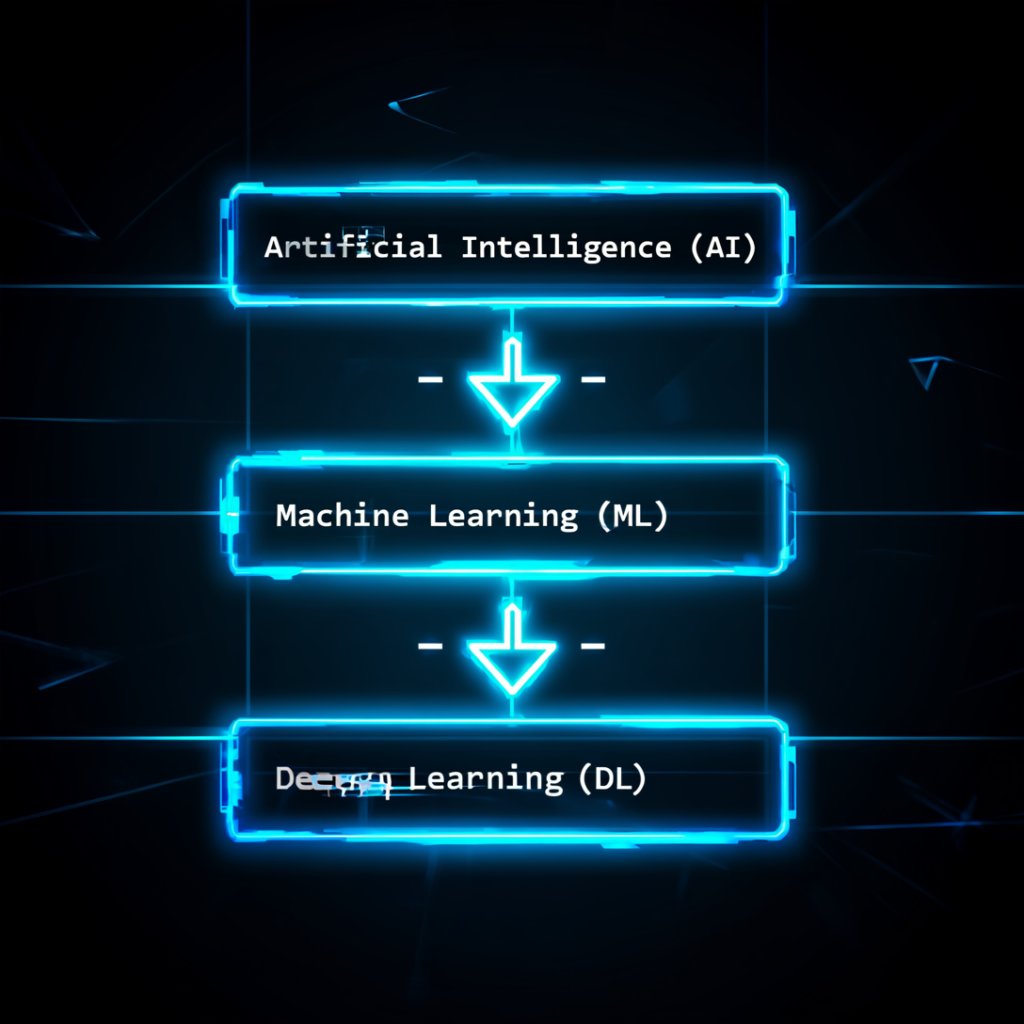
This diagram shows how Deep Learning is a part of Machine Learning, which in turn is part of Artificial Intelligence. In other words, all deep learning is machine learning, and all machine learning is AI, but not all AI is machine learning.
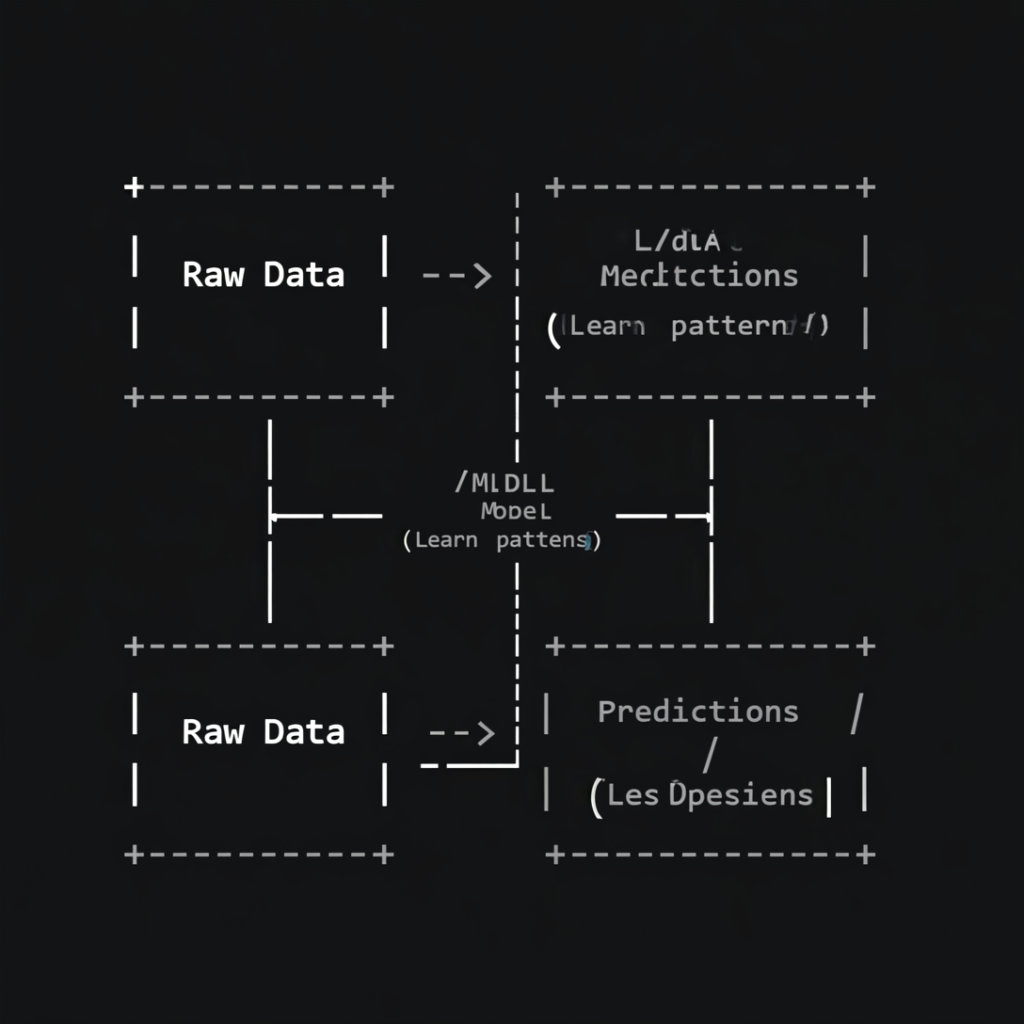
Here, raw data (like images, text, or numbers) goes into a learning model (ML or DL). The model learns patterns from that data, and then makes predictions or decisions on new data. For example, raw image pixels go into a neural network model, which then outputs “cat” or “dog”. These visual flows help illustrate how data flows into AI systems and how AI, ML, and DL relate.
5. Real-Life Examples
- Smartphones and Voice Assistants: When you talk to Siri or Google Assistant, AI and ML are at work. The voice recognition part often uses deep learning to understand your words, and AI logic decides how to respond or find information.
- Online Recommendations: Services like Netflix, YouTube, or Amazon use Machine Learning to suggest movies or products. They analyze what you’ve watched or bought in the past and find patterns to recommend something you might like.
- Email Spam Filter: Your email service (like Gmail) uses Machine Learning to detect spam. It learns from millions of examples of spam and non-spam emails to filter out unwanted messages for you.
- Social Media: When Facebook or Instagram recognizes faces in photos and suggests tags, they use Deep Learning (neural networks for face recognition).
- Healthcare: AI systems can analyze medical images (like X-rays or MRIs) to detect problems. For instance, a deep learning model might learn to spot signs of a fracture in an X-ray image.
- Student Tools: Educational apps may use AI to personalize learning. For example, a quiz app might use ML to adapt question difficulty based on your past answers. Another example is plagiarism checkers using AI to compare essays.
- Everyday Gadgets: Smart home devices (like thermostats or security cameras) use AI to learn your habits (when you’re home, what temperature you prefer) and adjust settings automatically.
- Banking and Finance: Banks use ML for fraud detection. If your card is used in a strange way, an ML model flags it. They also use AI to help decide loan approvals or to automate customer service with chatbots.
These examples show how AI, ML, and DL appear in daily products and services you might use.
6. Practical Use Cases
- Healthcare and Medicine: AI/ML is used to diagnose diseases and analyze medical data. For example, deep learning models can analyze MRI scans or X-rays faster and sometimes more accurately than humans. In drug discovery, ML helps predict how chemicals will behave.
- Automotive and Transportation: Self-driving cars and driver-assistance systems use deep learning to understand camera images and make driving decisions. Navigation apps use AI to predict traffic and suggest the fastest route.
- Finance and Banking: From credit scoring (deciding loan eligibility) to fraud detection (flagging suspicious transactions), banks rely on ML models. AI-powered chatbots in banks help customers with routine questions.
- Retail and E-commerce: Online stores use ML to recommend products (like what you might want to buy next). Inventory management uses AI to forecast demand and optimize stock levels.
- Entertainment and Media: Streaming services use ML for content recommendations (which songs or shows you might like). Video games use AI to create smarter opponents or to adapt the game difficulty to the player’s skill.
- Education: Schools and online learning platforms use AI to personalize lessons. For example, an AI tutor might give you extra practice on topics you struggle with. Universities analyze student performance data to improve teaching strategies.
- Manufacturing: AI-driven robots and inspection systems use deep learning to detect defects in products (like spotting a scratch on a smartphone screen).
- Smart Home/IoT: Many devices (security cameras, voice-controlled lights, thermostats) use AI. A smart camera might recognize familiar faces, and a thermostat learns your schedule to save energy.
- Environment and Agriculture: AI helps in weather forecasting, monitoring pollution, or analyzing soil data for farming. Drones with ML can monitor crops and detect plant diseases.
These use cases show AI/ML is used both in industry and in applications that even students might encounter in everyday life.
7. Exam Focus
Short Definitions:
- AI: Making machines that can perform tasks like human intelligence.
- ML: A type of AI where machines learn from data instead of being explicitly programmed.
- DL: A type of ML that uses neural networks with many layers to learn complex patterns.
Key Differences:
- AI vs ML: AI is the overall concept of intelligent machines. ML is a way to achieve AI by learning from data.
- ML vs DL: DL is a special kind of ML. Deep learning uses many-layered neural networks to learn complex patterns, while ML can use simpler algorithms (like decision trees).
- Scope: All DL models are ML models, and all ML is part of AI, but not all AI systems use ML or DL.
Important Points to Remember:
- AI is the umbrella term; ML and DL are specific approaches under AI.
- ML learns from examples (data). Deep learning learns features on its own from raw data.
- Deep learning can handle things like images and speech very well.
- ML needs training data (like labeled examples) to make predictions.
Sample Exam Questions:
- Define AI, Machine Learning, and Deep Learning with examples.
- How are machine learning and deep learning different?
- Give an example of an everyday application of AI or ML.
- What is a neural network and where is it used?
- List one advantage of deep learning over simpler ML methods.
Use this section to quickly review definitions and concepts before an exam!
8. Common Misconceptions
- “AI, ML, and DL are the same thing.” Actually, AI is the broad field, ML is a part of AI, and DL is a part of ML. It’s like saying “all apples are fruit, but not all fruits are apples.”
- “Deep Learning doesn’t need any data preparation.” Some think DL magically fixes all problems. In reality, DL still needs lots of good-quality data. If the input data is bad or biased, the results will be bad too.
- “Machine Learning can solve any problem.” ML is great for patterns in data, but it doesn’t replace common sense or creativity. Some problems are better solved with simple rules or human judgment. ML can’t handle everything.
- “AI means human-like consciousness.” Using AI doesn’t mean a machine truly understands like a human. Most AI today is “narrow AI” – it only does one specific task (like playing chess or recognizing faces), not general thinking.
- “More complex AI is always better.” Deep learning sounds fancy, but it isn’t always needed. Simpler models can be easier to train and explain. Also, deep models require much more computing power.
- “One model fits all tasks.” A common mistake is to try using a deep neural network for everything. But some tasks don’t need DL. For example, predicting a straight line with a simple formula might work better than a big neural network.
The truth: AI, ML, and DL are related but different. Each has its place. Use the right approach for the problem, and always verify that the AI is actually working as intended.
9. Advantages & Limitations
- AI:
- Advantages: Can automate complex tasks and mimic human decision-making. Useful in many fields (healthcare, finance, games). Helps speed up tasks that would take humans a long time.
- Limitations: Building true AI solutions is hard. AI systems may require a lot of data and computing power. Some AI can be unpredictable or biased if not carefully designed. AI also often works like a “black box,” where it’s hard to understand how it made a decision.
- Machine Learning (ML):
- Advantages: Learns and improves from data. Can adapt to new information automatically. Helpful for making predictions or finding patterns in data (like sales forecasting).
- Limitations: Depends on quality and quantity of data. If data is noisy or biased, results suffer. Models can overfit (perform well on training data but poorly on new data). ML models are often “black boxes,” so it’s hard to explain exactly why they make a certain decision.
- Deep Learning (DL):
- Advantages: Excels at handling very large and complex data (images, audio, text). It can automatically discover intricate patterns without manual feature design. Deep learning gives state-of-the-art results in vision, speech, and natural language tasks.
- Limitations: Requires very large datasets and powerful hardware (like GPUs) to train effectively. Models can be very slow to train. They are even more of a “black box” than other ML methods, meaning it’s hard to interpret their decisions. Deep models also need careful tuning of many parameters (like number of layers, learning rate, etc.).
10. Beginner Learning Path
- Learn Basic Math and Programming: Start with high school math (basic algebra, probability) and a programming language like Python. Coding skills are important to experiment with AI/ML.
- Explore AI Concepts: Understand what AI can do. Read intro articles or watch videos about AI, ML, and DL. Get familiar with simple terms (like “data” and “model”) without heavy math at first.
- Study Core ML Ideas: Learn how machines learn from data. Begin with concepts like data, features, and simple algorithms (e.g., linear regression or decision trees). Many free tutorials and courses introduce these step by step.
- Work on Small Projects: Apply what you learn by trying small projects. For example, use a dataset (like predicting house prices or weather) to build a simple ML model. Hands-on practice is crucial for understanding.
- Introduction to Neural Networks: Once comfortable with basic ML, learn about neural networks. Start with a single-layer network (perceptron). Understand how inputs, weights, and an activation function work.
- Learn Deep Learning Basics: Explore what makes a network “deep.” Try beginner-friendly libraries (like TensorFlow or PyTorch) through tutorials to build simple neural nets (for example, recognizing handwritten digits). Many online courses cover this with practical exercises.
- Practice and Build a Portfolio: Keep building projects as you learn. Try different types of problems: image classification, text analysis, etc. This reinforces learning and gives you examples to show others.
- Join Courses or Communities: Enroll in online courses (MOOCs) or study groups focused on AI/ML to guide your learning. Participate in forums (like Q&A sites or AI study groups) to ask questions and learn from others.
Remember: Learning AI/ML is a step-by-step process. Don’t rush into deep learning before you understand the basics of data and simple models. Each step builds on the previous one.
11. Future Scope
- Growing Demand: AI, ML, and Deep Learning skills are in high demand. Many tech companies, startups, and even traditional industries look for people who understand these concepts. Roles like AI engineer, data scientist, and ML developer are popular career paths.
- Career Opportunities: Knowing the differences helps students aim for roles that suit them. For example, if you enjoy statistics and data, you might become a data scientist (focus on ML). If you enjoy coding and engineering, perhaps an AI software developer. Understanding deep learning is useful for jobs in computer vision or voice technology.
- Expanding Fields: New fields like self-driving vehicles, robotics, healthcare technology, and personalized medicine rely heavily on AI/ML. Even areas like agriculture, environment, and education are adopting AI solutions.
- Continued Learning: Technology evolves fast. Today’s beginner knowledge of AI/ML opens doors to advanced topics later (like reinforcement learning, AI ethics, or specialized ML fields). Stay curious and keep learning new developments.
- Impact on Society: AI and ML will continue to shape how we live and work. As a student, being familiar with these concepts helps you understand news and future changes (like how AI might affect jobs or daily life in your field).
- Integration with Other Tech: AI/ML often links with other technologies like big data, cloud computing, and the Internet of Things (IoT). Knowing AI concepts prepares you for these interconnected areas of tech.
Overall, learning AI, ML, and DL sets the stage for careers in cutting-edge technology and offers many paths as these fields grow.
12. Summary
- AI is the broad idea of machines performing tasks that usually require human intelligence. ML is a method in AI where machines improve by learning from data. DL is a specialized form of ML using deep neural networks.
- Remember the hierarchy: AI > ML > DL. Every deep learning system is a machine learning system, and every machine learning system is a type of AI, but not all AI uses ML or DL.
- In real life, AI/ML/DL power things like your smartphone assistant, online recommendations, and even cars. Knowing how they work (in simple terms) helps you understand modern technology.
- For exams, focus on clear definitions, key differences, and examples (like those in the Exam Focus section above). Key terms include data, model, neural network, and training.
- The future of tech jobs heavily involves AI and ML, so learning these topics now builds a strong foundation. Keep practicing with examples and projects to reinforce your understanding.