Why Artificial Intelligence Is Such a Hot Topic Right Now
Artificial Intelligence is everywhere lately, mostly because it quietly powers so many of the smart apps we use every day. Your phone unlocks by recognizing your face, a streaming app somehow knows which movie you’ll like, and a chatbot answers your question at 2 a.m. — all of that runs on Artificial Intelligence. So why does it matter so much right now? Because it’s reshaping how we work and live, and understanding even the basics can open doors across dozens of fields and careers.
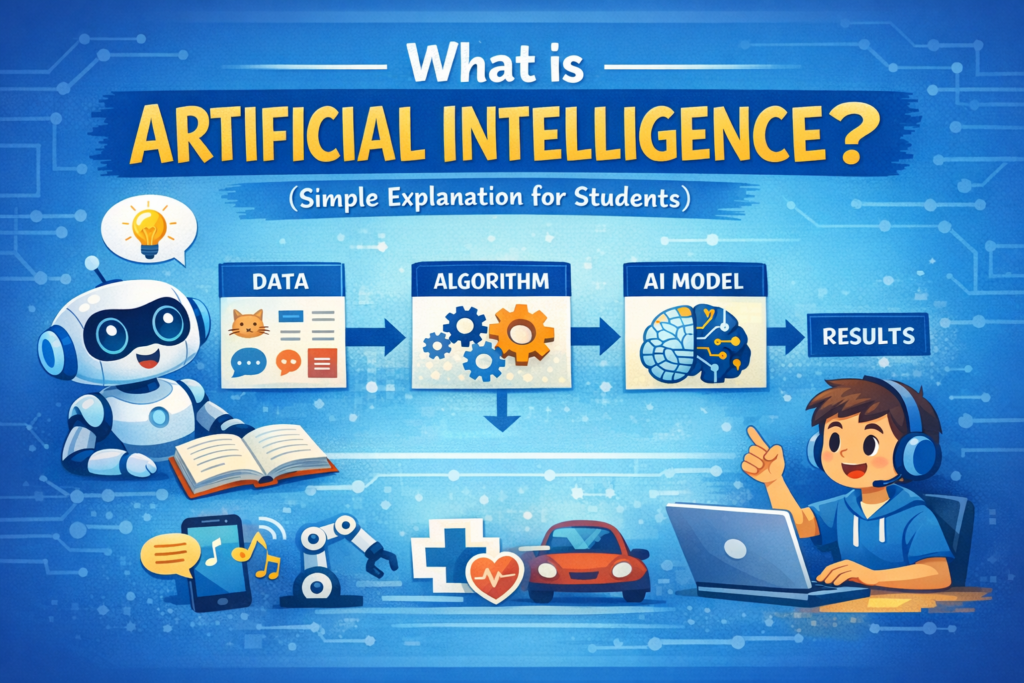
Here’s a comparison that makes the whole idea easier to hold onto: picture Artificial Intelligence as a study partner rather than a mysterious black box. Think about how you personally learn something new — you look at a few examples, practice, and gradually get better at solving similar problems. A computer learns in a strikingly similar way. We feed it a pile of examples, or data, and it slowly picks up on the patterns hiding inside. Show a computer thousands of labeled cat and dog photos, for instance, and it eventually gets good at telling the two apart on its own. In that sense, Artificial Intelligence behaves like a student that learns through repetition and experience, and then puts that learning to work for us.
A Simple Definition of Artificial Intelligence
At its core, Artificial Intelligence is the branch of technology that teaches computers to think and learn in a limited, task-specific way. Put differently, it lets machines take on jobs that would normally need a human mind — understanding speech, recognizing images, making decisions, or even playing a game.
To ground this in something familiar, think about how a small child learns to name animals. They look at pictures, hear the names repeated, and slowly connect the two. A computer learns in much the same fashion: we hand it a large batch of examples — pictures, words, sounds — and it draws its own conclusions from them. When your phone understands what you just said out loud, that’s speech recognition at work. When an app suggests a movie you end up loving, that’s a recommendation system doing its job. Both are everyday, unglamorous examples of the concept in action.
Broken down to its simplest parts: artificial just means “made by people, not occurring naturally,” while intelligence means “the ability to think, learn, and make decisions.” Put those together, and Artificial Intelligence essentially means machines picking up a limited version of the way humans think and learn.
Human Intelligence vs. Machine Intelligence
Human intelligence is the brainpower behind thinking, learning, and understanding the world. Machine intelligence — the “AI” in Artificial Intelligence — describes computers attempting similar tasks, even though they don’t have a brain in any real sense. Instead, they run on programmed instructions, and Artificial Intelligence is really an effort to get those instructions to handle tasks that normally demand real thought, like solving a puzzle or following a spoken sentence.
People learn through lived experience — reading, practicing, making mistakes. Machines, on the other hand, learn from whatever data we hand them. Both can genuinely improve with time, but a machine does it by crunching information through algorithms rather than living through anything.
Data: The Fuel Behind Artificial Intelligence
Data is simply information, whether that’s numbers, images, text, or sound. Any Artificial Intelligence system needs a steady supply of it to learn anything useful. A stack of cat and dog photos, for example, becomes the training data an AI system uses to learn what separates the two animals.
Much like a student needs textbooks and practice problems, an AI model needs plenty of solid examples. Generally speaking, the more good-quality data it sees, the better it gets at spotting patterns and making accurate predictions later on.
Machine Learning: Teaching Computers by Example
Machine Learning (ML) is one of the main techniques used to build Artificial Intelligence. Rather than writing out a fixed rule for every possible situation, we let the computer study a pile of data and work out the underlying rules on its own.
Picture it as handing a computer thousands of examples paired with their correct answers, and letting it figure out the pattern connecting the two. To teach a system to catch spam email, for instance, you show it plenty of spam messages alongside plenty of normal ones. Over time, it learns to spot the difference by itself.
A few common flavors of Machine Learning show up again and again:
- Supervised learning — the computer studies labeled examples (input paired with the correct output) and learns the relationship between them.
- Unsupervised learning — the computer sifts through data with no labels attached and hunts for hidden groupings or patterns on its own.
- Reinforcement learning — the computer tries different actions and learns from the feedback it gets, whether that’s a reward or a penalty, much like learning through trial and error.
Algorithms and Models in Artificial Intelligence
An algorithm is basically a step-by-step recipe — a defined set of rules a computer follows. In Artificial Intelligence, algorithms sift through data looking for patterns worth learning from.
Once an algorithm finishes learning from a dataset, it produces something called a model. A model is the finished product of all that learning: a formula, or a decision-making tool, that the computer can then reuse.
Say the goal is predicting house prices. The algorithm might generate a model — essentially a mathematical formula — built from years of past housing data. Feed that model a brand-new house, and it spits out a predicted price. Once trained, a model gets reused again and again: new data goes in, and a decision or prediction comes out the other side.
Narrow AI vs. General Artificial Intelligence
Narrow AI (or weak AI) describes systems built for one specific job. A voice assistant, a movie recommendation engine, or the vision system inside a self-driving car all count as narrow AI — each excels at its one task but can’t do much of anything else.
General AI (or strong AI), on the other hand, is still purely hypothetical: a machine with human-level intelligence across any task you could throw at it. Nothing like that exists yet, though it’s a favorite subject in science fiction and long-term research.
As things stand today, every real-world Artificial Intelligence system falls into the narrow category. Each one learns a specific task from data — recognizing images, translating a sentence, or playing a particular game — and nothing beyond that.
Everyday Examples of Artificial Intelligence
- Smartphones and voice assistants. Ask your phone “what’s the weather?” out loud, and Artificial Intelligence handles both understanding your speech and finding you an answer.
- Online searches. Search engines lean on it to guess what you’re actually looking for and surface relevant results almost instantly.
- Media recommendations. Streaming apps study your habits, then suggest movies, shows, or songs based on what you’ve already enjoyed.
- Social media feeds. An algorithm decides which posts and ads show up first, aiming to keep you scrolling through things you’re likely to care about.
- Email filters. Spam and junk get quietly sorted out of your inbox automatically, thanks to pattern recognition running in the background.
More Everyday Examples Worth Knowing
- Navigation apps. GPS tools calculate the fastest route and predict traffic jams in real time, adjusting as conditions change.
- Photo apps. Your phone’s camera recognizes faces and suggests filters or edits on the fly.
- Language translation. Some online services convert text from one language into another almost instantly.
- Customer support chatbots. These tools answer common questions the moment you type them, without a human on the other end.
- Smart appliances. Robot vacuums and smart thermostats learn your habits over time and start adjusting automatically.
Where Industries Rely on Artificial Intelligence
Healthcare. Doctors use Artificial Intelligence to scan medical images like X-rays for early warning signs, and it also assists with diagnosing conditions and suggesting treatment options.
Finance and banking. Banks lean on it to flag unusual transactions that might signal fraud, and it helps assess loan applications far faster than a person could alone.
Retail and e-commerce. Online stores use it to recommend products, manage inventory levels, and adjust pricing on the fly.
Manufacturing. Factory robots powered by Artificial Intelligence assemble products, and predictive systems flag machines likely to break down before it actually happens.
Even More Places Artificial Intelligence Shows Up
Transportation. Self-driving systems rely on it to recognize roads, signs, and obstacles, and city planners use similar tools to improve traffic flow and transit schedules.
Education. Software can personalize lessons for each student, adjusting difficulty and offering feedback based on how someone’s actually performing.
Agriculture. Farmers use drones and sensors, guided by Artificial Intelligence, to monitor crops and decide exactly when to water or harvest.
Entertainment. Video games use it to control non-player characters so they react intelligently, while movie studios lean on it for animation and visual effects.
Environmental science. Researchers use it to predict weather patterns, study climate data, and even identify species in field photos, aiding conservation work.
Key Terms and Common Exam Questions
Short definitions:
- Artificial Intelligence — the simulation of human-like reasoning and learning by machines.
- Machine Learning — a subfield of Artificial Intelligence where computers improve by studying examples rather than following fixed rules.
Questions you might actually be asked:
- What is Artificial Intelligence, in simple terms?
- How does Machine Learning connect to Artificial Intelligence more broadly?
- Give a real-life example of Artificial Intelligence in daily life.
Worth remembering: computers need both data and algorithms to function; Machine Learning (and sometimes deep learning) sits underneath the broader idea of Artificial Intelligence; and, at its core, the whole field is really about imitating narrow slices of human ability.
Two distinctions worth knowing cold:
- Artificial Intelligence vs. Machine Learning — Artificial Intelligence is the broad umbrella covering intelligent machines generally, while Machine Learning is one specific method for getting there using data.
- Narrow AI vs. General AI — narrow systems handle one job well (similar to a calculator), while general intelligence would tackle any intellectual task a human can, something that doesn’t exist in practice yet.
Common Misconceptions About Artificial Intelligence
“It thinks like a human brain.” In reality, these systems have no feelings or consciousness — they’re simply following patterns buried in data. A model can look remarkably clever, but it doesn’t actually “understand” anything the way a person does; it just processes input according to how it was built.
“It can solve absolutely any problem.” Not quite — Artificial Intelligence only performs well on tasks it was specifically trained for, and its decisions rest entirely on the data it has already seen. Push it outside that training, and it has no real way to cope.
“It’s always correct.” Beginners often assume the output must be right simply because a computer produced it. However, mistakes happen constantly, especially when the underlying data was biased or incomplete. A model trained on too few examples of something will often misclassify it.
“It will replace every job.” There’s a common fear that Artificial Intelligence will wipe out human work entirely. In practice, while it automates plenty of repetitive tasks, it also creates new roles and tools, and people are still needed to design, maintain, and work alongside these systems. Often it just makes existing work easier rather than replacing it outright.
“Only experts can use it.” Plenty of people assume the field is too complicated to touch without a technical background. Advanced work certainly demands deep study, but beginners can start with simple concepts today, and no shortage of approachable resources exist for exactly that purpose.
Advantages and Limitations of Artificial Intelligence
What it does well:
- Automates repetitive, tedious tasks
- Works faster than a human ever could on the same job
- Improves and refines itself over time as it sees more data
- Runs 24/7 without ever getting tired
- Spots patterns in large datasets that a person would likely miss
Where it falls short:
- Needs large amounts of data to perform reliably
- Lacks genuine common sense or creativity
- Can end up biased if the training data itself was biased
- Sometimes makes mistakes while appearing entirely confident
- Building a solid system in the first place is genuinely complex work
A Beginner’s Path Into Artificial Intelligence
- Start with computer basics. Get comfortable with how computers actually work and pick up some basic programming logic, even through something simple like block-based coding.
- Refresh basic math. Arithmetic, algebra, and a little statistics or probability go a long way toward understanding how data gets processed and how algorithms behave.
- Get hands-on with data. Play with a simple spreadsheet, sort a small dataset, and look for basic trends — this builds real intuition before anything technical shows up.
- Study the core concepts. Beginner-friendly courses, videos, or books can introduce ideas like algorithms and models without diving into heavy math right away.
- Try a small project. Write a short program to recognize handwritten digits, or sort text into categories, using free tools available online.
- Join a community. Study groups and forums are genuinely useful — someone else has almost certainly hit the same confusion you’re stuck on.
- Keep building. Once the basics feel solid, move on to bigger ideas like neural networks, and build a small portfolio of projects along the way.
The Future of Artificial Intelligence
Career opportunities. Artificial Intelligence remains one of the fastest-growing corners of tech, and roles like AI engineer, data scientist, or machine learning engineer are in serious demand, often with strong salaries attached.
Industry-wide growth. Nearly every sector — healthcare, finance, manufacturing, entertainment — now leans on it to improve products and services, so learning the fundamentals can open doors well beyond a single industry.
Ongoing innovation. It sits at the center of tech that’s still emerging, from self-driving cars to advanced robotics, so understanding the basics puts you closer to genuinely cutting-edge work.
Cross-disciplinary reach. Because it connects with math, biology, and design alike, these skills pay off even in careers that aren’t traditionally considered “tech” at all.
Summary: What Artificial Intelligence Really Means
Artificial Intelligence is the technology that lets machines take on tasks like learning, reasoning, and problem-solving in ways that resemble human thought, even if the resemblance is only partial. It learns from large volumes of data using algorithms, builds a model out of that learning, and then uses the model to make predictions or decisions on brand-new data it hasn’t seen before.
We run into it constantly — through voice assistants, search engines, recommendation systems, and dozens of quieter tools across healthcare, finance, and transportation. The key relationship worth remembering is simple: Artificial Intelligence is the broad field, and Machine Learning is one major way of actually achieving it.
As the field keeps evolving, getting a handle on these fundamentals now sets you up well, whether that means acing an exam or laying the groundwork for a future career built around this technology. In short, it’s really about teaching computers to act a little smarter using data and algorithms — and that idea alone makes it one of the more exciting areas for students to explore right now.
If you’re curious how this connects to the tools built on top of it, our guides on what an API is and Python for beginners cover the pieces that often sit underneath real Artificial Intelligence projects. For a deeper technical overview from outside sources, IBM’s explainer on Artificial Intelligence and Stanford’s Human-Centered AI Institute are both solid places to dig further.