If you have used internet over the last year, you are already familiar with AI chatbots. You ask a question, and the AI generates an answer. But what if the AI didn’t just talk to you? What if it could actually perform tasks, use software, and make decisions on its own?
Welcome to the world of Agentic AI—the next major evolution in computer science.
While most of the world is still learning the basics in standard Artificial Intelligence courses, top tech companies are quietly shifting their focus to autonomous AI agents. In this beginner-friendly guide, we will break down exactly what Agentic AI is, how it works, and why understanding it could be the biggest boost to your tech career.
What is Agentic AI?
Agentic AI refers to artificial intelligence systems that possess “agency.” In simple English, this means the AI can act independently to achieve a specific goal without a human guiding every single step.
Think of traditional AI like a highly intelligent encyclopedia. You have to ask it exactly what you want, and it gives you information.
Agentic AI, on the other hand, is like hiring a virtual employee. Instead of asking it, “How do I build a website?” you would tell an Agentic AI, “Build a website for my coffee shop.” The AI would then break the project down into steps, write the code, generate the images, test the website for errors, and publish it—all on its own.
How is Agentic AI Different from Traditional AI?
To understand why this technology is taking the computer science world by storm, you have to look at the core differences:
- Action over Text: Standard AI generates text, images, or code. Agentic AI executes workflows. It can click buttons, navigate websites, and use APIs.
- Self-Correction: If a traditional AI writes bad code, it stops and waits for you to fix it. If an Agentic AI writes bad code, it reads the error message, realizes its mistake, rewrites the code, and tests it again.
- Memory and Context: AI agents have a continuous loop of memory. They remember what they did five steps ago and use that information to decide what to do next.
How Do Autonomous Agents Actually Work?
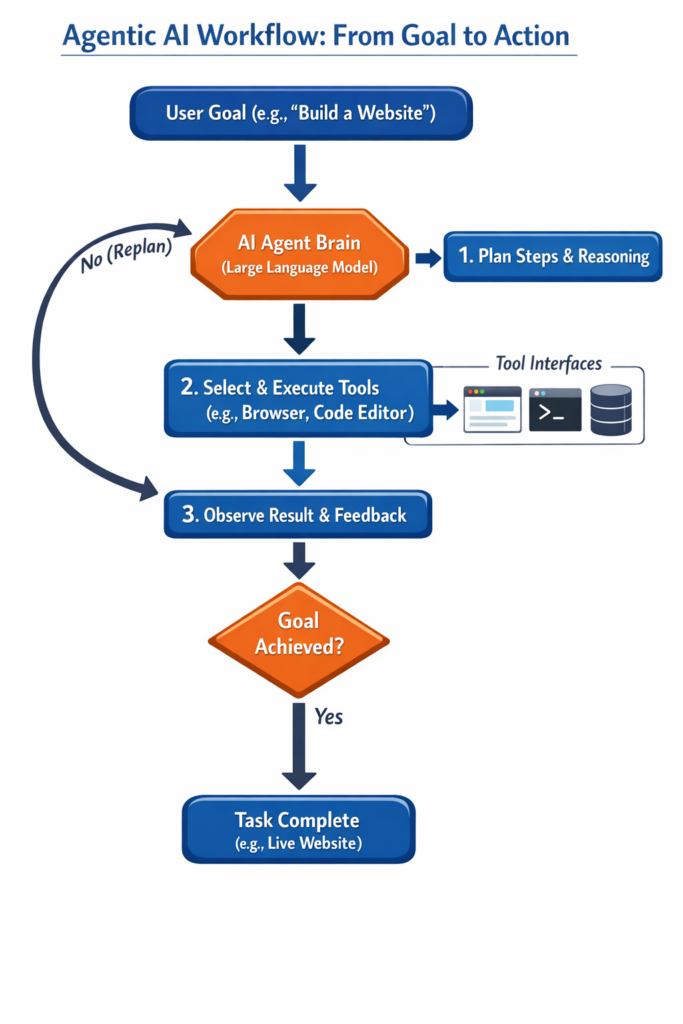
You don’t need a PhD in machine learning to understand the mechanics behind Agentic AI. At its core, an AI agent relies on three main components:
- The Brain (Large Language Models): The agent uses models like GPT-4 or Claude as its core reasoning engine. This allows it to understand your initial command.
- The Tools: This is where the magic happens. Programmers give the AI access to tools. This could be a web browser, a calculator, a code editor, or other modern tech tools and software
- The Planning Loop: The AI uses a framework (like LangChain or AutoGPT) to create a to-do list. It looks at the goal, plans the necessary steps, uses its tools to complete step one, checks if it worked, and then moves to step two.
Real-World Examples of Agentic AI
This technology is not science fiction; it is happening right now. Here is how Agentic AI is currently being used across different industries:
- Software Development: Tools like Devin (the first AI software engineer) can be assigned a coding bug. The agent will read the codebase, find the bug, write the patch, and test it without human intervention.
- Data Analysis: Instead of manually writing Python scripts to organize an Excel file, an AI agent can be given raw data and told to “find the trends.” It will clean the data, write the formulas, and generate a visual dashboard.
- Cybersecurity: “Digital Immune Systems” use Agentic AI to constantly monitor a network. If a hacker tries to break in, the AI agent automatically identifies the threat, blocks the IP address, and patches the security flaw in real-time.
Why You Should Learn About Agentic AI Today
The tech industry rewards those who stay ahead of the curve. Right now, learning how to build and manage AI agents is a highly specialized, low-competition niche.
For students and beginners getting into programming, learning how to connect an AI model to external tools using languages like Python is one of the most lucrative skills you can develop. Companies are no longer just looking for people who can write code; they are looking for people who can automate entire workflows.
The Bottom Line
We are moving away from an era where humans have to constantly supervise computers. Agentic AI is transforming machines from passive assistants into active, problem-solving partners. By understanding how these autonomous agents work, you are positioning yourself at the forefront of the modern tech revolution.
Are you ready to dive deeper into the world of AI and programming? Check out our step-by-step courses designed to turn complex computer science topics into simple, real-world skills.