
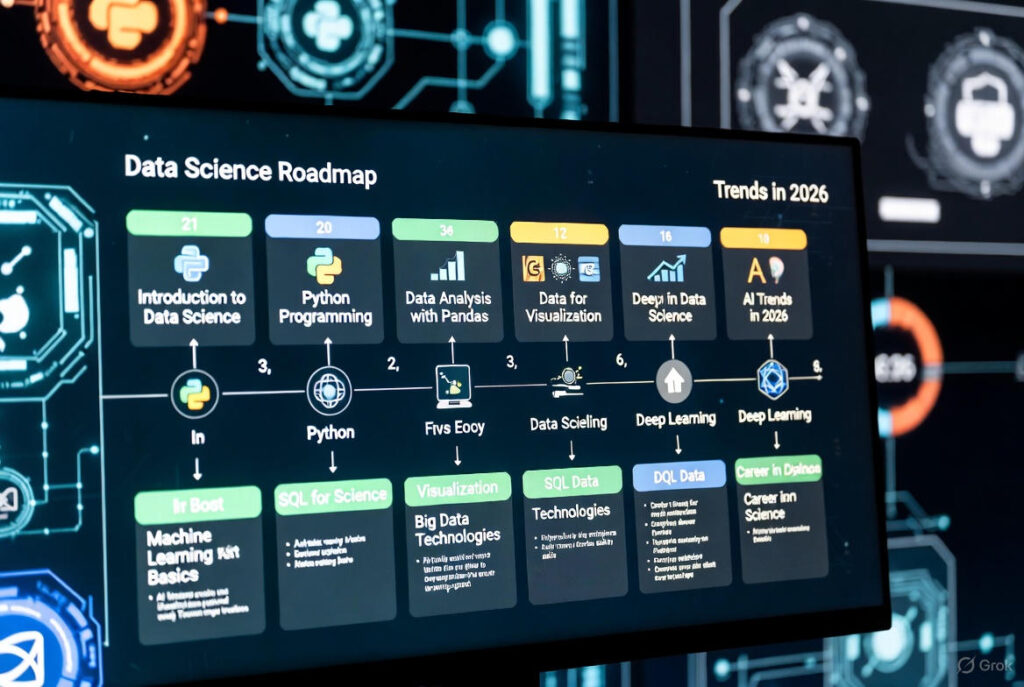
If you’re putting together a data science roadmap for beginners in 2026, there’s a new item you can’t skip: agentic AI. Chances are you’ve already messaged a regular chatbot at some point. You type a question, it types back an answer. Simple enough. But a newer kind of system is showing up in data work now — one that doesn’t just answer, but clicks through software, makes decisions, and finishes tasks without anyone watching every move.
That shift is called Agentic AI, and any serious data science roadmap for beginners should account for it early.
Why This Belongs on Your Data Science Roadmap
Most people are still getting comfortable with basic AI tools. Meanwhile, the bigger labs have already moved on to something bigger: agents that operate on their own. For anyone building a data science roadmap for beginners, understanding this shift matters more than memorizing another library. Below is what it means, how it works, and why it’s worth learning now.
What Exactly Is Agentic AI?
Focus on the word “agency.” Agentic AI describes systems that act on their own toward a goal, without someone walking them through every step.
Here’s a useful comparison. A regular AI model works like a fast reference book. You ask it something specific. It hands you an answer. The exchange ends there.
Agentic AI works more like hiring a new employee. Ask a traditional model to “build a website for my coffee shop,” and you’ll get very little back. You’d have to break that request into a dozen smaller questions yourself. Hand the same instruction to an agentic system, though, and it runs with it. It writes the code, creates the images, checks the site for bugs, and publishes it — largely without hand-holding.
What Actually Separates It From Regular AI
A few things set this apart, and each is worth understanding on its own.
It does things instead of just describing them. A normal AI model outputs text, an image, or a block of code, then stops. An agent goes further. It clicks through a website, calls an API, or operates other software directly.
It catches its own mistakes. Give a regular AI a coding task and it messes up. That’s where things stop; you’re the one who has to notice the bug and hand it back. An agent skips that wait. It reads the error, works out what went wrong, rewrites the code, and checks it again.
It keeps track of where it’s been. Agents don’t reset after every response. Each one holds onto what happened a few steps back and uses that history to plan its next move. This is a big part of how they manage multi-step tasks without losing the thread.
How These Agents Actually Work
You don’t need a machine learning degree to follow this. Strip it down, and an agent runs on three pieces working together.
A reasoning engine comes first. The agent typically runs on a large language model — something like GPT-4 or Claude — and that model handles the actual understanding of what you’ve asked it to do.
Access to tools comes next. This is where the whole thing becomes useful rather than theoretical. Developers connect the model to things it can actually use: a web browser, a calculator, a code editor, or whatever other software the task calls for.
A planning loop ties it together. Using a framework like LangChain or AutoGPT, the agent builds itself a to-do list. It looks at the end goal, works out the steps needed, tackles the first one with whatever tool fits, checks whether it worked, and only then moves to the next step.
Where This Is Already Being Used
This isn’t some far-off concept for your data science roadmap for beginners — it’s already running in production, across a handful of industries.
Take software development. Tools like Devin, often described as the first AI software engineer, can take a bug report, dig through the codebase to find the source, write a fix, and test it, all without a developer stepping in.
Or take data analysis. Instead of manually writing scripts to clean up a spreadsheet, you can hand an agent raw data and tell it to find the trends. It cleans the dataset, writes the formulas it needs, and puts together a dashboard on its own.
Cybersecurity offers another example. So-called “digital immune systems” use agentic AI to watch a network around the clock. The moment something suspicious shows up, the agent identifies the threat, blocks the offending IP, and patches the vulnerability before a human ever gets involved.
A Quick Bit of History
None of this appeared out of nowhere. For years, “AI” mostly meant a model that answered a question or generated an image on request. One input, one output, done. The turning point came once language models got reliable enough to reason through multi-step problems and connect to real tools instead of just producing text into a void.
Early experiments like AutoGPT and BabyAGI showed up in various online communities and were rough around the edges. They got stuck in loops. They misread their own output. Sometimes they wandered off task entirely. But they proved something important: give a language model a goal, a memory of its own actions, and access to a few tools, and it starts chaining steps together without a human typing each one in. That proof of concept is what today’s agentic systems build on, just with far more reliability and far better tool integration.
What Sets a Good Agent Apart From a Broken One
Not every system that calls itself agentic actually behaves like one. A few traits separate the ones that genuinely work from the ones that just look impressive in a demo.
Reliability under pressure. A good agent doesn’t fall apart the moment something unexpected happens — a webpage loads slowly, an API returns an error, a file shows up in the wrong format. It adjusts instead. A weak one gets stuck and either stalls out or repeats the same failed action over and over.
Knowing when to stop and ask. Counterintuitively, the more capable agents often know their own limits. Say a task is genuinely ambiguous — a budget wasn’t specified, or a decision could go two very different directions. A well-built agent pauses and checks in rather than guessing and running with it.
Efficient use of resources. Every step an agent takes, and every tool it calls, costs time and computing power. A sloppy agent might take twenty steps to do something a well-designed one handles in five. That gap matters a lot once you’re running these systems at real scale.
The Risks Nobody Should Skip Over
It’s tempting to focus only on the upside. But handing decision-making power to a system that acts on its own comes with real trade-offs.
Errors compound faster. A traditional AI that writes something wrong causes limited damage; the mistake just sits on a screen until a person acts on it. Give that same wrong assumption to an agent that can act, and the error can snowball, because the agent keeps building on its own mistake without anyone catching it in the moment.
Oversight gets harder, not easier. Ironically, the more autonomous a system becomes, the more effort it takes to supervise well. Someone still has to review what it did, understand why, and catch problems before they turn expensive.
Security exposure grows. An agent that can browse the web, touch files, or call external APIs also carries a bigger attack surface. Trick it, through a manipulated webpage or a poisoned document, into taking the wrong action, and the consequences run far more concrete than a bad chatbot reply.
Accountability gets murky. When an autonomous system makes a costly decision, pinning down who’s responsible isn’t always simple. The builder, the deployer, and the company that owns the outcome could all share the blame. The legal and ethical frameworks around this are still catching up.
None of this means the technology isn’t worth using. It just means “autonomous” doesn’t mean “unsupervised.” The companies getting the most out of agentic AI right now pair it with careful monitoring instead of pulling humans out of the loop entirely.
More Places This Is Already Showing Up
Agentic systems are quietly working their way into a wider range of everyday business functions, beyond software, data, and security.
Customer support is one example. Agents can handle entire ticket resolutions: reading a complaint, pulling up the relevant order history, issuing a refund if policy allows it, and closing the ticket, escalating to a human only when something falls outside the rules.
Recruiting and HR offer another. Some companies use agents to screen resumes against a job description, schedule interviews across several calendars, and send standardized follow-up communication. What used to take days of back-and-forth email now takes a few minutes of automated coordination.
Finance and operations teams use them too. Agents reconcile spreadsheets, flag unusual transactions that might signal fraud, and draft first versions of quarterly reports by pulling numbers from multiple internal systems.
In personal productivity, a growing number of tools let you hand off an entire task. Book a flight within a budget. Research and summarize a topic. Organize a messy inbox. You get a finished result back instead of a list of suggestions you still have to act on yourself.
Agentic AI vs. Traditional AI, Side by Side
Seeing the contrast laid out plainly helps more than scattering it across paragraphs.
A traditional AI model answers a question and stops. An agent keeps working toward a goal across many steps, without needing a fresh prompt each time.
A traditional model holds no memory of its own actions within a task. An agent tracks what it already tried, what worked, and what didn’t, then adjusts.
A traditional model can describe how to do something. An agent can go and actually do it, using real tools and real software.
A traditional model stops the moment it hits an error. An agent, in most cases, notices that error and tries to correct course on its own.
Common Questions People Ask About Agentic AI
Does this mean regular AI chatbots are becoming obsolete? Not really. They solve different problems. Sometimes you just want a quick answer, and a full agentic workflow would be overkill for that. Expect the two approaches to coexist.
Do I need to learn a specific programming language to work with this? Python is the most common choice right now, mostly because most major agent frameworks and AI libraries are built around it. That said, the underlying concepts — goals, tools, memory, feedback loops — matter more than any one language.
Is this the same thing as robotics? No, though the two overlap in some cases. Agentic AI is software making decisions and taking digital actions: clicking, writing, calling APIs. Robotics involves physical movement in the real world. An agent could, in theory, control a robot, but the two terms aren’t interchangeable.
How far away is this from being fully mainstream? Depending on the industry, it already is here. Software development and customer support have adopted agentic tools fairly aggressively. Healthcare and law are moving more cautiously, largely because of the accountability questions raised earlier.
Why This Belongs Early on Your Data Science Roadmap
The tech industry rewards whoever gets there first. Right now, building and managing AI agents is still a narrow, underexplored skill. That means less competition for anyone willing to learn it early.
New to programming? Learning to connect a language model to outside tools using something like Python is quickly becoming one of the more valuable skills around. Companies aren’t just hiring people who can write code anymore. They want people who can automate whole workflows from start to finish.
Where This Leaves Us
We’re moving past the point where computers need constant supervision to get anything done. Agentic AI turns software from something that waits for instructions into something that solves problems on its own. Any data science roadmap for beginners built in 2026 that skips this piece is already out of date. Understanding how these systems work now puts you ahead of a curve that’s only getting steeper.
Suggested next reads: link this post internally to your related “Career Roadmaps” category page and to any existing posts on Python for beginners or machine learning fundamentals — replace the bracketed suggestions below with your actual post URLs.
- [Internal link suggestion: Python for Data Science — Where to Start] → /category/career-roadmaps/python-for-beginners/
- [Internal link suggestion: Machine Learning Roadmap] → /category/career-roadmaps/machine-learning-roadmap/