AI Engineer Roadmap: Beginner to Advanced Practical Journey
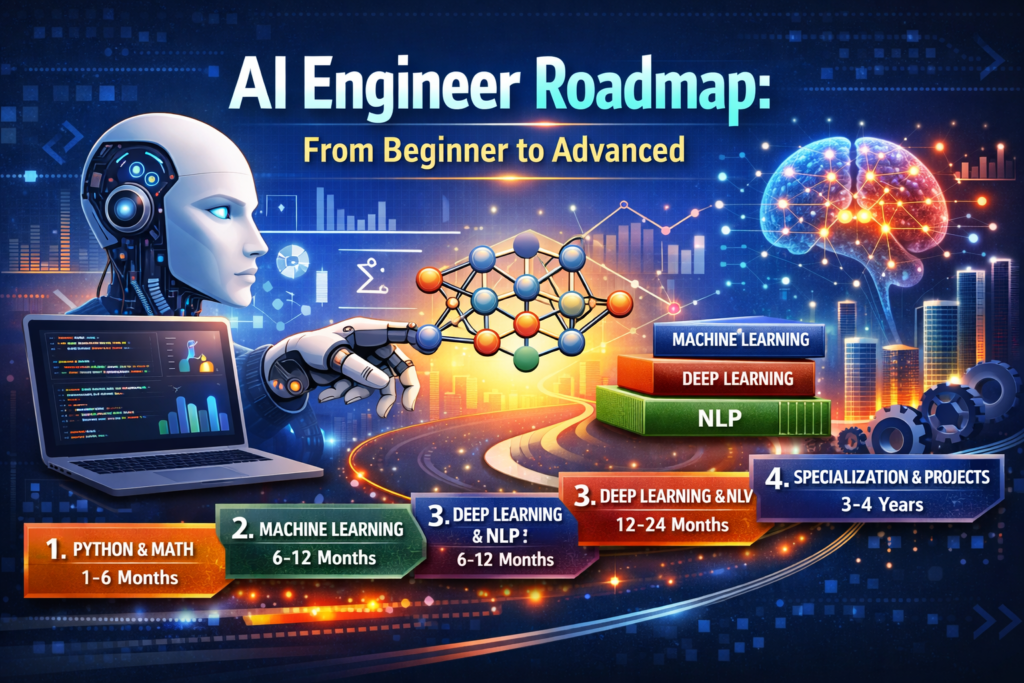
The field of Artificial Intelligence (AI) is vast and evolving rapidly. To navigate this journey, a step-by-step roadmap helps break the learning path into manageable phases. An AI engineer typically starts with strong programming and mathematical foundations, then progresses to core machine learning (ML) concepts, deep learning, natural language processing, and finally specialized applications and real-world projects.
As a rough estimate, a complete beginner may need about 1–2 years of consistent study to master the fundamentals, while someone with existing coding skills could accelerate this journey to 6–12 months. Below is a structured roadmap with clear timeframes and key skills for each phase, suitable for learners from high school to university level.

Phase 1 (Months 0–6): Foundations & Basics
Begin by mastering the essentials. Spend the first few months solidifying your programming and math skills, since AI systems rely on both. Focus on Python programming, which is the lingua franca of AI development. Practice writing clean, well-structured code, and learn basic tools like version control (Git/GitHub) and data notebooks (Jupyter). At the same time, build your mathematical foundation: study linear algebra (vectors, matrices), calculus (derivatives, gradients), and probability/statistics (distributions, averages, hypothesis testing). Understanding these concepts will help you grasp how models learn. This phase also includes learning to work with data: practice using libraries like Pandas for data manipulation and Matplotlib or Seaborn for visualization. Duration: ~3–6 months.
- Python programming (syntax, data structures, functions)
- Basic algorithms and data types (loops, conditionals, file I/O)
- Linear algebra fundamentals (vectors, matrices, dot products)
- Calculus and optimization basics (derivatives, gradients, loss functions)
- Probability and statistics essentials (mean, variance, distributions, sampling)
- Tools: Git/GitHub for code management, virtual environments for dependencies
Phase 2 (Months 6–12): Core Machine Learning
With the basics in place, move on to machine learning (ML). Learn the difference between supervised learning (using labeled data) and unsupervised learning (finding patterns without labels). Study classic ML algorithms: linear and logistic regression, decision trees, random forests, k-means clustering, and principal component analysis (PCA). Use a library like scikit-learn to train and evaluate models on real datasets. Key theory concepts here include model evaluation and tuning: understand train/test splits, cross-validation, and metrics like accuracy, precision/recall, and mean squared error. Also learn about overfitting vs. underfitting and how regularization (like dropout or L2 penalty) helps generalize. Practical projects at this stage might include predicting house prices, classifying emails as spam, or clustering customer data. By the end, you should feel comfortable turning raw data into a trained ML model. Duration: ~6 months.
- Supervised learning: regression (linear, logistic) and classification algorithms (trees, k-NN)
- Unsupervised learning: clustering (k-means, hierarchical) and dimensionality reduction (PCA)
- Model evaluation: accuracy, precision/recall, F1 score, ROC curves, cross-validation
- Avoiding overfitting: train/test split, regularization techniques (L1/L2, dropout)
- Tools: scikit-learn for building models, Pandas for data cleaning, Matplotlib/Seaborn for plotting
- Mini-projects: build a classifier (e.g., spam filter, digit recognizer) and a regressor (e.g., house-price predictor)
Phase 3 (Year 1–2): Deep Learning & Practical Projects
Next, dive into deep learning (DL), which powers modern AI breakthroughs. Spend the following 6–12 months learning how neural networks work. Study the basics of neural nets: how layers of neurons use activation functions to learn patterns, and how backpropagation and gradient descent train them. Explore key architectures:
- Convolutional Neural Networks (CNNs) for image and signal data (e.g., classify images, detect objects).
- Recurrent Neural Networks (RNNs) and Transformers for sequence and language data (e.g., text generation, translation).
- Transfer learning and pre-trained models: fine-tune existing models (like ResNet for vision or BERT for NLP) to save time.
Learn to use popular DL frameworks like TensorFlow/Keras or PyTorch. Practice on larger datasets (e.g., CIFAR-10 images, IMDB movie reviews) and consider using free GPUs or cloud services (Google Colab, AWS) to handle the compute. This phase is very hands-on: build and train your own networks. For example, create an image classifier (cats vs dogs, MNIST digits) or train an RNN to do sentiment analysis or generate text. Also begin exploring Generative AI basics: simple autoencoders and an introduction to GANs (Generative Adversarial Networks) that create new images. By working through these projects, you’ll learn how to tune architectures, preprocess data (augment images, tokenize text), and debug training issues. Duration: ~6–12 months.
- Neural network fundamentals: layers, neurons, activations (ReLU, sigmoid), loss functions
- CNNs for vision tasks: convolutions, pooling layers, common networks (e.g., VGG, ResNet)
- RNNs/LSTMs and Transformers for NLP: handling sequences, attention mechanisms, large language models (GPT, BERT)
- Generative models: autoencoders, basic GAN architecture, text-generation with RNNs or transformer
- Frameworks: TensorFlow/Keras or PyTorch for building and training models
- Practical projects: image classifier (e.g., cats vs. dogs), NLP model (e.g., sentiment analysis), experiment with data augmentation
Phase 4 (Year 2+): Specialization & Career Prep
In the long term, tailor your learning to specific domains and real-world deployment. Spend the next 1–2+ years (or more) deepening expertise and applying your skills:
- Specialize: Pick an area that excites you. This could be computer vision (advanced image segmentation, object tracking), natural language processing (chatbots, machine translation), reinforcement learning (game or robotics tasks), or generative AI (fine-tuning GPT models, image generation with diffusion models). Work through advanced courses or papers in that field.
- Cutting-edge topics: Keep up with trends like large language models (LLMs), reinforcement learning algorithms (policy gradients, Q-learning), and emerging areas (AI ethics, fairness, explainability). Understanding the theory behind these (e.g., how attention or policy gradients work) will set you apart.
- End-to-end projects: Build full AI systems. This means collecting or accessing data, preprocessing it, training your model, and then deploying it. Learn to use tools like Docker or Flask to wrap your model in an API, and try hosting a demo on cloud platforms (AWS, Google Cloud, or even a simple web server). For example, you might develop an AI-driven web app that recognizes images or summarizes text.
- Professional skills: Work on collaborative projects to simulate real software development – use Git branches, code reviews, and issue tracking. Strengthen soft skills: practice explaining your projects clearly, writing clean README files, and preparing for interviews by reviewing fundamentals and doing coding exercises.
- Portfolio & networking: Throughout this phase, maintain a portfolio of your work (e.g., GitHub repositories, Kaggle competitions, academic papers or blog posts). Participate in hackathons, open-source projects, or research collaborations to gain experience. Attend local meetups or online forums to learn from peers and mentors.
- Academic path (optional): If you’re a university student, take related coursework (algorithms, data structures, AI/ML classes) and consider a capstone or research project in AI. A formal degree can complement this roadmap but focus on practical outcomes.
Duration: Ongoing. As you build advanced skills, the timeline becomes flexible. Over 1–2+ years (or through a 3–4 year university program), you can repeatedly cycle through learning new topics, doing projects, and reflecting on what to study next.
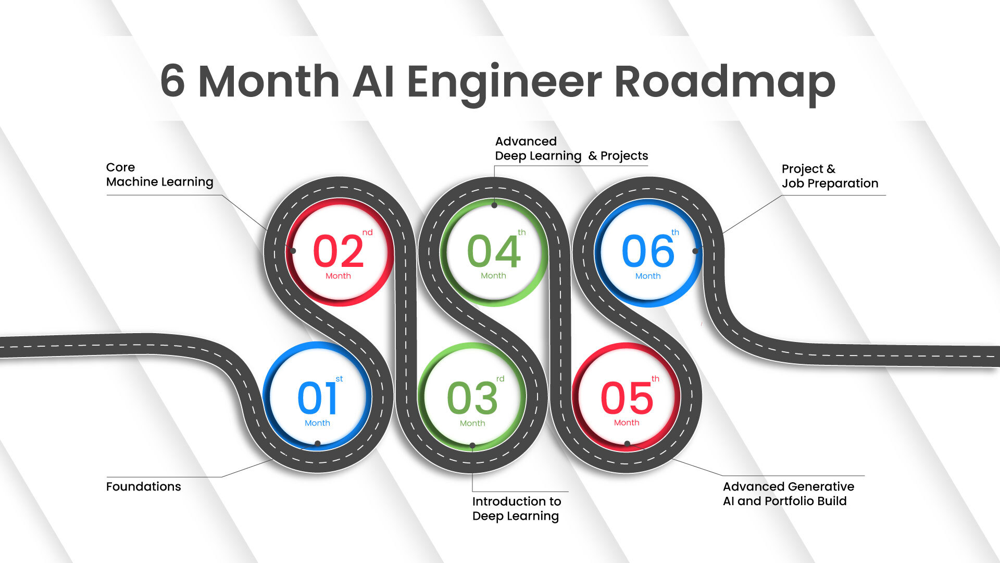
Example Roadmap Visualization
Key Tips & Next Steps
- Build hands-on projects: Reinforce learning by doing. For every new concept, try to code it or apply it in a mini-project. This solidifies theory and reveals gaps in understanding.
- Stay consistent: Set a regular study schedule (even an hour a day) and stick to it. Consistency beats cramming.
- Learn to debug: Expect models to fail or not learn at first. Debugging (checking your data, tuning hyperparameters) is where you really learn.
- Use community resources: Take advantage of free tutorials, online courses, textbooks, and forums like Stack Overflow. Discussing problems with peers can accelerate learning.
- Review fundamentals often: Occasionally revisit basic math and programming concepts so they stay fresh, even as you tackle advanced topics.
- Keep up with trends responsibly: Read blogs or summaries about new AI developments (transformers, diffusion models, etc.), but balance this with hands-on practice. Also study AI ethics and privacy issues as you learn.
Every AI journey is unique. Whether you follow this path in six months or over several years, focus on practical skills and a solid grasp of theory. Regular projects, curiosity, and persistence are as important as any specific timeline. Good luck on your AI engineering adventure!