Why You Need an AI Engineer Roadmap
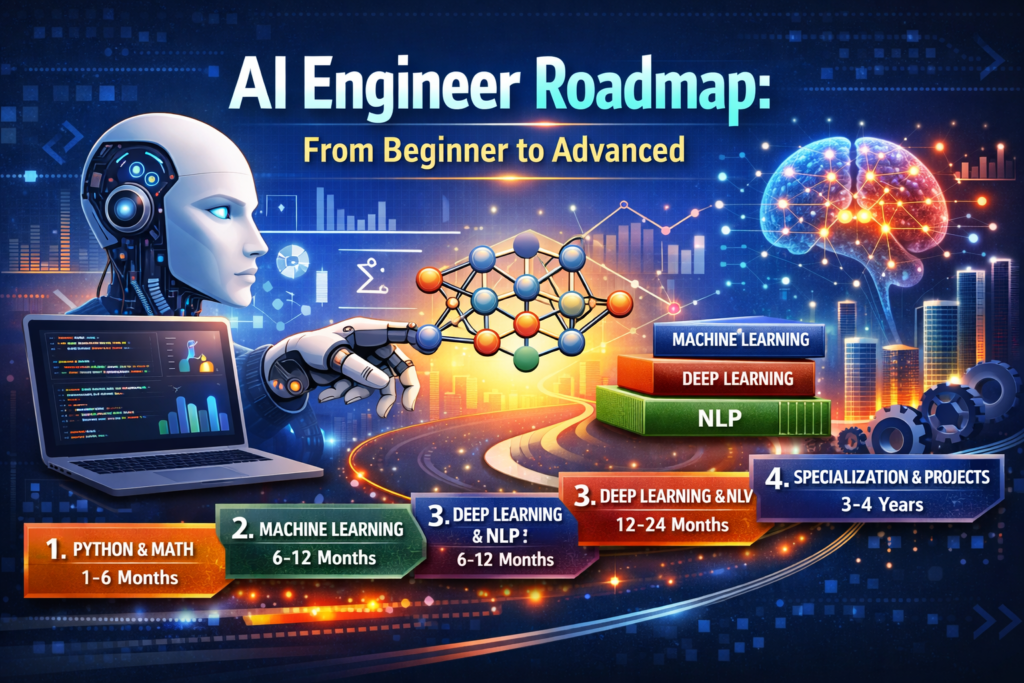
Artificial Intelligence keeps growing at a pace that’s hard to keep up with, so having a clear AI engineer roadmap makes the whole learning process far less overwhelming. Instead of jumping randomly between tutorials, a roadmap breaks the journey into manageable phases: strong programming and math foundations first, then core machine learning, followed by deep learning and natural language processing, and finally specialized, real-world projects.
As a rough estimate, a complete beginner might need about 1–2 years of steady study to nail the fundamentals, whereas someone who already codes could realistically compress that down to 6–12 months. Below is a structured version of this roadmap, with clear timeframes and key skills for each phase, aimed at learners anywhere from high school through university level.
Phase 1 of the AI Engineer Roadmap: Foundations and Basics (Months 0–6)
Start by locking down the essentials. Spend the first few months building solid programming and math skills, since every AI system leans on both. Python deserves most of your early attention, since it’s essentially the lingua franca of the field. Practice writing clean, well-organized code, and pick up basic tools like Git/GitHub for version control and Jupyter notebooks for experimenting with data.
At the same time, work on your math foundation: linear algebra (vectors, matrices), calculus (derivatives, gradients), and probability or statistics (distributions, averages, hypothesis testing). These ideas matter because they explain how models actually learn under the hood. This phase also includes getting comfortable with data itself — practicing with libraries like Pandas for manipulation and Matplotlib or Seaborn for visualization. Roughly speaking, this stage takes 3–6 months.
Skills to cover in this phase:
- Python programming (syntax, data structures, functions)
- Basic algorithms and data types (loops, conditionals, file I/O)
- Linear algebra fundamentals (vectors, matrices, dot products)
- Calculus and optimization basics (derivatives, gradients, loss functions)
- Probability and statistics essentials (mean, variance, distributions, sampling)
- Tools: Git/GitHub for code management, virtual environments for dependencies
Phase 2 of the AI Engineer Roadmap: Core Machine Learning (Months 6–12)
Once the basics feel solid, move on to machine learning itself. Learn the difference between supervised learning, where you train on labeled data, and unsupervised learning, where the goal is finding patterns without any labels at all. Study the classic algorithms — linear and logistic regression, decision trees, random forests, k-means clustering, and principal component analysis (PCA) — and use a library like scikit-learn to train and evaluate models on real datasets.
A big chunk of the theory here revolves around evaluating and tuning models: train/test splits, cross-validation, and metrics like accuracy, precision, recall, and mean squared error. It also helps to understand overfitting versus underfitting, and how regularization techniques (like dropout or an L2 penalty) keep a model from memorizing its training data instead of actually learning from it. Practical projects at this stage often include predicting house prices, filtering spam emails, or clustering customer data. By the end, turning raw data into a trained model should feel routine rather than intimidating. This phase generally runs about 6 months.
Skills to cover in this phase:
- Supervised learning: regression (linear, logistic) and classification algorithms (trees, k-NN)
- Unsupervised learning: clustering (k-means, hierarchical) and dimensionality reduction (PCA)
- Model evaluation: accuracy, precision/recall, F1 score, ROC curves, cross-validation
- Avoiding overfitting: train/test splits, regularization techniques (L1/L2, dropout)
- Tools: scikit-learn for building models, Pandas for cleaning data, Matplotlib/Seaborn for plotting
- Mini-projects: a classifier (spam filter, digit recognizer) and a regressor (house-price predictor)
Phase 3 of the AI Engineer Roadmap: Deep Learning and Practical Projects (Year 1–2)
Next comes deep learning, the engine behind most recent AI breakthroughs. Plan on spending the following 6–12 months learning how neural networks actually work — how layers of neurons use activation functions to pick up patterns, and how backpropagation paired with gradient descent trains the whole system.
A few architectures are worth exploring in depth: Convolutional Neural Networks (CNNs) for image and signal data, useful for tasks like classifying photos or detecting objects; Recurrent Neural Networks (RNNs) and Transformers for sequence and language data, which handle things like text generation and translation; and transfer learning, where you fine-tune an existing pre-trained model (ResNet for vision, or BERT for language) instead of starting from zero.
Get comfortable with one of the major frameworks, either TensorFlow/Keras or PyTorch. Practice on larger datasets — CIFAR-10 images or IMDB movie reviews, for example — and take advantage of free compute through Google Colab or a cloud provider like AWS.
More on Phase 3 of the AI Engineer Roadmap: Hands-On Practice
This part of the journey is heavily hands-on: build and train your own networks, whether that’s an image classifier (cats vs. dogs, or MNIST digits) or an RNN doing sentiment analysis. It’s also worth peeking into generative AI basics, like simple autoencoders and an introduction to GANs, which learn to create entirely new images. Working through these projects teaches you how to tune architectures, preprocess data, and debug training problems as they come up. This phase typically takes 6–12 months.
Skills to cover in this phase:
- Neural network fundamentals: layers, neurons, activations (ReLU, sigmoid), loss functions
- CNNs for vision tasks: convolutions, pooling layers, common networks (VGG, ResNet)
- RNNs/LSTMs and Transformers for NLP: sequences, attention mechanisms, large language models (GPT, BERT)
- Generative models: autoencoders, basic GAN architecture, text generation with RNNs or transformers
- Frameworks: TensorFlow/Keras or PyTorch for building and training models
- Practical projects: an image classifier, an NLP model, and some experimentation with data augmentation
Phase 4 of the AI Engineer Roadmap: Specialization and Career Prep (Year 2+)
Further along, the goal shifts toward tailoring your skills to a specific domain and getting real projects into production. Expect to spend the next 1–2+ years (sometimes longer) deepening your expertise and putting it to actual use.
Pick a specialty. Choose an area that genuinely interests you — computer vision (advanced segmentation, object tracking), natural language processing (chatbots, translation), reinforcement learning (games, robotics), or generative AI (fine-tuning language models, diffusion-based image generation). Work through advanced courses or research papers in whichever area you land on.
Track cutting-edge topics. Stay current with large language models, reinforcement learning techniques like policy gradients and Q-learning, and emerging concerns around AI ethics, fairness, and explainability. Understanding the theory behind these ideas — how attention mechanisms or policy gradients actually work — sets you apart from someone who just knows the buzzwords.
Build end-to-end systems. This means collecting or sourcing data, preprocessing it, training a model, and deploying the finished product. Learn to wrap a model in an API using tools like Docker or Flask, then host a working demo on a cloud platform such as AWS or Google Cloud. A good example project might be a web app that recognizes images or summarizes text on request.
Rounding Out the AI Engineer Roadmap: Professional Skills and Portfolio
Sharpen professional habits. Work on collaborative projects that mimic real software development — use Git branches, go through code reviews, and track issues properly. Alongside that, practice explaining your work clearly, write genuinely useful README files, and prepare for interviews by revisiting fundamentals and working through coding exercises.
Build a visible portfolio. Throughout this whole phase, keep a running portfolio of your work: GitHub repositories, Kaggle competitions, blog posts, or academic papers if you go that route. Hackathons, open-source contributions, and research collaborations all add real experience, and local meetups or online forums are great places to learn from people further along than you.
Consider the academic route. If you’re studying at a university, coursework in algorithms, data structures, or dedicated AI/ML classes fits naturally alongside this path, and a capstone or research project can tie things together nicely. A formal degree can complement this roadmap, but the practical outcomes matter more than the paper itself.
Overall, this phase doesn’t really end — as you build advanced skills, the timeline becomes flexible. Over 1–2+ years, or across a 3–4 year university program, you’ll likely cycle repeatedly through learning something new, building a project around it, and reflecting on what to tackle next.
Key Tips for Following This AI Engineer Roadmap
- Build hands-on projects. Reinforce every new concept by coding it or applying it in a small project. This is what solidifies theory and exposes the gaps in your understanding.
- Stay consistent. Set a regular study schedule, even if it’s just an hour a day, and stick with it — consistency beats cramming almost every time.
- Learn to debug. Expect models to fail or refuse to learn at first. Debugging — checking your data, tuning hyperparameters — is honestly where most of the real learning happens.
- Lean on community resources. Free tutorials, courses, textbooks, and forums like Stack Overflow exist for a reason. Talking through problems with peers speeds everything up.
- Revisit fundamentals often. Occasionally circle back to basic math and programming concepts so they stay sharp, even once you’re deep into advanced material.
- Follow trends responsibly. Read up on new developments like transformers or diffusion models, but balance that reading with actual hands-on practice, and make time to study AI ethics and privacy along the way.
Every AI engineer roadmap ends up looking a little different in practice. Whether you move through this path in six months or stretch it across several years, what matters most is practical skill and a genuine grasp of the underlying theory. Regular projects, curiosity, and plain persistence count for just as much as any specific timeline.
If you’re just starting out, our guides on Python for beginners, what an API actually is, and what Artificial Intelligence means cover a lot of the groundwork this roadmap builds on. Good luck on your journey.