
1. Why People Mix These Up
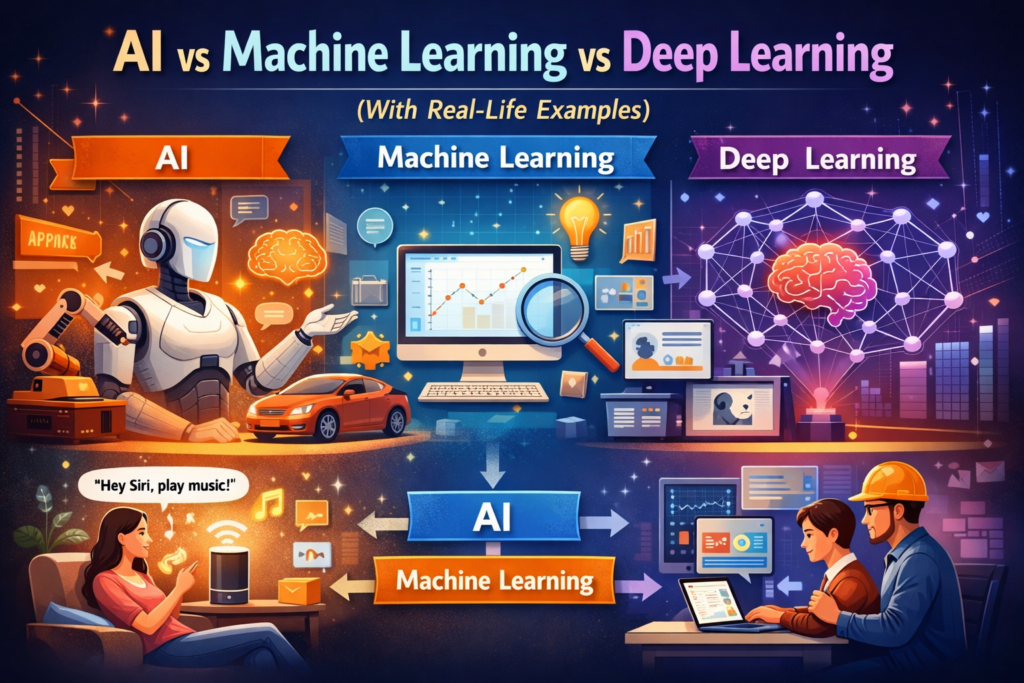
Ask five people to explain the difference between AI, Machine Learning, and Deep Learning, and you’ll probably get five different answers — half of them wrong. That’s not really their fault. The three terms get thrown around interchangeably in headlines, product descriptions, and casual conversation, so it’s no wonder the lines blur. Yet understanding AI vs Machine Learning (and where Deep Learning fits into that picture) matters, because these aren’t three separate things sitting side by side. They’re nested inside one another, and knowing how helps you see what’s actually happening when your phone unlocks with your face or Netflix somehow knows what you want to watch next.
Here’s a way to picture it: think of AI as “Science” on a school timetable, Machine Learning as the “Chemistry” unit within that subject, and Deep Learning as “Organic Chemistry” — a narrower topic tucked inside Chemistry. Once that nesting clicks, the rest of this gets a lot easier. We’ll walk through plain definitions, everyday examples, and a couple of simple diagrams below, so by the end you’ll be able to explain this at a dinner party without sounding like you memorized a textbook.
(If you want to go deeper afterward, check out our guides on building an AI roadmap or getting started with an introduction to Machine Learning — but for now, let’s stick to the fundamentals.)
2. The Simple Version First
Artificial Intelligence is the umbrella term. Picture any machine or program built to do something we’d normally expect a human to do — hold a conversation, recognize a face, make a decision. Siri answering your question? That’s AI. It doesn’t matter whether it’s running on rigid rules a programmer wrote or on something it figured out by itself; if it’s mimicking human-like judgment, it falls under AI.
Machine Learning is one particular route to building AI. Rather than a developer coding every rule by hand, the system studies a mountain of examples and works out the patterns on its own. A spam filter that gets better at catching junk mail the more emails it sees? That’s ML in action.
Deep Learning narrows things further still. It’s Machine Learning built on layered structures called neural networks, loosely modeled on how neurons in a brain connect and fire. Stack enough of these layers together and the system starts teaching itself increasingly abstract patterns — which is exactly how your phone recognizes your face or transcribes your voicemail into text.
A quick shortcut for remembering the pecking order: AI is the destination — smart machines. ML is one road that gets you there — learning from data. DL is a faster, steeper road on that same route — neural networks doing the heavy lifting.
3. Breaking Down Each One
What Falls Under Artificial Intelligence
AI isn’t a single technique; it’s the whole field. Anything that makes a machine act intelligently counts, whether that’s a rigid set of coded rules or a system that learns on its own.
The goal, broadly, is getting machines to handle tasks that would otherwise need a human brain — understanding a sentence, spotting an object in a photo, deciding what move to make next in a game.
You’ll find AI behind chess engines, virtual assistants like Alexa, self-driving vehicles, and plenty of robotics work. Some of it runs on straightforward if-this-then-that logic (an old-school medical expert system matching symptoms to a diagnosis, say); other parts lean on statistics and probability instead.
Where Machine Learning vs Deep Learning Starts to Diverge
Machine Learning sits inside AI, but the defining trait is that it learns from data rather than from a programmer’s instructions. Feed it enough examples, and it builds its own internal model — one it can then apply to information it’s never seen before. A spam filter, again, is a textbook case: train it on thousands of emails already labeled “spam” or “not spam,” and it starts making that call on its own.
There are a few flavors worth knowing:
- Supervised learning — the system trains on labeled pairs of input and known output. Predicting a house’s sale price from its square footage and location is a classic example.
- Unsupervised learning — no labels involved; the algorithm just hunts for structure. Grouping shoppers by purchasing habits without telling it what the groups should be is a good illustration.
- Reinforcement learning — learning through trial, error, and feedback, the way a game-playing AI improves by getting rewarded for good moves and penalized for bad ones.
Netflix suggesting your next binge-watch? That’s ML studying your viewing history and spotting patterns in it.
And Then Deep Learning
Deep Learning takes the “learning from data” idea and runs it through neural networks — many layers of simple decision units, each one picking up on a slightly different feature of the input. Early layers might notice edges in an image; later ones start recognizing shapes, then faces.
The word “deep” simply refers to how many layers are stacked — sometimes dozens, sometimes hundreds. More layers generally mean the system can pick up on more intricate patterns, though it also means more computing muscle is required to train it.
This is the technology behind image recognition, natural language processing, and speech-to-text — anything where the input is messy, high-dimensional data like pixels or sound waves. When Instagram suggests who to tag in a photo, there’s a neural network doing the face-matching behind the scenes.
4. Picturing the Relationship
The cleanest way to visualize this is as three nested circles: Deep Learning sits inside Machine Learning, which sits inside Artificial Intelligence. Every deep learning system counts as machine learning, and every machine learning system counts as AI — but plenty of AI exists that never touches ML or DL at all (that old rule-based expert system, for instance).
You can also think of it as a pipeline: raw data — pixels, text, audio — flows into a model. The model hunts for patterns in that data, then spits out a prediction. Feed in the pixels of a photo, and a neural network might hand back the label “cat” or “dog” on the other end. That flow is essentially what’s happening any time an AI system makes a call about something it’s never directly seen before.
5. Where You Actually Run Into This Stuff
- Your phone’s voice assistant. When you ask Siri or Google Assistant a question, deep learning is doing the heavy lifting on understanding your speech, while broader AI logic decides how to respond.
- Streaming recommendations. Netflix, YouTube, and Amazon all lean on Machine Learning, sifting through what you’ve watched or bought to guess what you’ll want next.
- Your inbox’s spam filter. Gmail and similar services train ML models on millions of flagged emails so junk never reaches you.
- Photo tagging on social media. Facebook and Instagram use Deep Learning-powered face recognition to suggest who’s in your pictures.
- Medical imaging. Radiologists increasingly get a second opinion from deep learning models trained to spot things like fractures in X-rays.
- Study tools. Some quiz apps quietly adjust question difficulty using ML based on how you’ve answered before; plagiarism checkers lean on AI to compare submitted essays against a huge reference set.
- Smart thermostats and cameras. These learn your habits — when you’re usually home, what temperature you like — and adjust without being told.
- Bank fraud alerts. If your card gets used somewhere unusual, an ML model is often what flags it, sometimes within seconds.
6. Real Industry Applications
Healthcare — Deep learning models can scan MRIs and X-rays faster than a human reviewer, sometimes catching things people miss. In drug discovery, ML helps predict how a new compound might behave before it ever reaches a lab bench.
Transportation — Self-driving systems depend on deep learning to interpret camera feeds in real time, while everyday navigation apps use AI to forecast traffic and reroute you around it.
Finance — Credit scoring, fraud detection, and those “Hi, how can I help?” bank chatbots all run on some flavor of ML or AI.
Retail — Product recommendations, demand forecasting, and stock optimization all lean on machine learning behind the scenes.
Entertainment — Song and show recommendations come from ML; smarter, more adaptive video game opponents often come from AI techniques layered on top.
Education — Personalized lesson plans and performance tracking increasingly rely on AI to tailor material to individual students.
Manufacturing — Deep learning-powered inspection systems catch defects — a scratch on a phone screen, a misaligned part — faster than a human eye could.
Agriculture — Drones equipped with ML can fly over fields and flag early signs of crop disease before it spreads.
7. Quick-Reference for Exams or Interviews
One-line definitions:
- AI — building machines that can perform tasks normally requiring human intelligence.
- ML — a branch of AI where the machine learns from data instead of following explicit programming.
- DL — a branch of ML that uses many-layered neural networks to learn complex patterns.
Key distinctions:
- AI is the umbrella concept; ML is one method of achieving it.
- DL is a specialized subset of ML — it leans on deep neural networks, while other ML approaches (decision trees, for instance) can be much simpler.
- Every DL model is an ML model, and every ML model is an AI system — but the reverse isn’t true.
Worth remembering:
- AI is the umbrella; ML and DL are specific techniques underneath it.
- ML needs labeled or structured data to learn from; DL can often pull features straight from raw, messy data.
- DL tends to shine with images, audio, and text.
Practice questions to test yourself:
- Define AI, Machine Learning, and Deep Learning, each with an example.
- What separates machine learning from deep learning?
- Name an everyday product that relies on AI or ML.
- What is a neural network, and where does it typically get used?
- Give one advantage deep learning has over simpler ML methods.
8. Myths Worth Retiring
“AI, ML, and DL are basically the same thing.” Not quite — AI is the broad field, ML is one approach within it, and DL is a further specialization within ML. Every apple is a fruit, but not every fruit is an apple.
“Deep learning doesn’t need clean data.” It still does — arguably more than simpler methods, since deep networks are very good at learning bad patterns if you feed them bad data.
“Machine learning can solve literally anything.” It’s excellent at finding patterns in data, but it doesn’t replace judgment or creativity. Some problems are still better handled by a human or a simple rule.
“AI means the machine actually understands things.” Most AI in use today is “narrow AI” — built to do one job well (recognize faces, play chess) without anything resembling genuine understanding.
“Bigger and more complex is always better.” Deep learning gets a lot of hype, but it’s overkill for plenty of problems. A basic linear model can outperform a giant neural network on a simple, well-behaved dataset — and it’s far easier to explain and maintain.
9. Weighing the Trade-Offs
AI — automates complex tasks and speeds up work that would otherwise take humans far longer, but building it well is genuinely hard, and it can behave unpredictably or reflect hidden biases if it wasn’t designed carefully.
Machine Learning — adapts as new data comes in and is great at spotting patterns humans might miss, but it’s only as good as the data it’s trained on. Feed it noisy or biased data and you’ll get noisy or biased predictions; overfitting to training data is a constant risk.
Deep Learning — delivers standout results on images, audio, and text, and can discover patterns without anyone hand-engineering features. The cost is steep, though: large datasets, serious GPU horsepower, long training times, and models that are notoriously hard to peer inside and explain.
10. A Realistic Path for Beginners
- Get comfortable with basic math and a programming language. Algebra, a little probability, and Python will take you further than you’d expect.
- Read around the topic before diving into code. Get familiar with terms like “model” and “data” so the jargon stops being intimidating.
- Learn the fundamentals of ML. Linear regression and decision trees are a solid starting point — plenty of free tutorials walk through them step by step.
- Build something small. Predict house prices, forecast the weather, whatever — hands-on practice beats passive reading every time.
- Move on to neural networks. Start with a single-layer perceptron and understand how inputs, weights, and activation functions interact before going deeper.
- Try a beginner-friendly deep learning library. TensorFlow or PyTorch tutorials on recognizing handwritten digits are a common, approachable entry point.
- Keep building a portfolio. Vary your projects — image classification one week, text analysis the next — to reinforce what you’ve learned.
- Find a community. Courses, forums, and study groups make the learning curve far less lonely.
Don’t rush toward deep learning before the basics of data and simple models feel solid — each step really does build on the last.
11. Where This Is All Heading
Demand for people who understand AI, ML, and DL keeps climbing across nearly every industry, not just tech. Job titles like AI engineer, data scientist, and ML developer are becoming common well beyond Silicon Valley.
Knowing the distinctions helps you aim your career more precisely. Drawn to statistics and data analysis? Data science, with its heavy ML focus, might suit you. More interested in engineering and systems? AI software development could be the better fit. Fascinated by vision or speech technology specifically? That’s deep learning territory.
Fields like autonomous vehicles, robotics, personalized medicine, and precision agriculture are all leaning harder on these tools every year — and as a student or early-career professional, understanding the basics now sets you up to follow (or join) that growth later.
12. The Short Version
AI is the big idea: machines doing things that normally require human intelligence. ML is a method within AI — learning from data rather than being explicitly programmed. DL is a specialized form of ML, built on deep neural networks.
Keep the hierarchy straight: AI contains ML, and ML contains DL. Every deep learning system is a machine learning system, and every machine learning system is a form of AI — but plenty of AI exists outside ML and DL entirely.
You already run into all three daily, whether it’s your phone’s assistant, a streaming recommendation, or a car’s driver-assist feature. Understanding the difference between AI vs Machine Learning — and how Deep Learning fits underneath both — makes the technology around you a lot less mysterious, and it’s a solid foundation if you’re heading toward a career in the field.